
Why Company Analysis Is the First Step of KYB
Know Your Business verification begins long before sanctions screening or adverse media checks. The first task in any corporate due diligence process is understanding the company itself. Compliance teams must confirm that a legal entity exists, determine what the company actually does, identify who controls it, and assess whether its activities present regulatory risks.
Many financial institutions are now exploring AI-driven tools to accelerate these investigations, reflecting broader industry changes in compliance technology. A deeper overview of these developments can be found in our analysis of AI compliance trends shaping the industry.
In practice, this stage is often the most time-consuming part of KYB. Analysts typically search across multiple corporate registries, review company websites, check open-source information, and manually map ownership structures. A single investigation can require navigating five to ten different tools and databases. Depending on jurisdiction and company complexity, collecting this information may take hours or even days.
This fragmented process slows onboarding and creates inconsistency in compliance investigations. Data is scattered across sources, documentation must be assembled manually, and analysts must reconcile conflicting information before any risk assessment can begin.
What is business verification?
Business verification is the process of confirming that a company legally exists, identifying its owners and managers, understanding its business activities, and evaluating potential compliance risks before onboarding the company as a client.
What is KYB verification?
KYB (Know Your Business) verification is a compliance process used by financial institutions and regulated companies to verify corporate customers. It typically includes company registry verification, identification of beneficial owners, sanctions screening, and adverse media monitoring.
What Compliance Teams Need Before Screening Starts
Before sanctions screening, PEP checks, or adverse media monitoring begin, compliance teams must first establish a clear understanding of the company they are reviewing. Screening tools can detect risk signals, but they only become meaningful when analysts know exactly which entity they are investigating.
The first stage of the KYB process focuses on building a reliable profile of the company. Compliance analysts must confirm that the entity exists in official registries, determine its business activity, identify its ownership structure, and understand which jurisdictions are involved. These elements form the foundation of any corporate due diligence workflow.
Without this context, screening results can easily be misinterpreted. Companies may share similar names, ownership structures may be layered across multiple jurisdictions, and business descriptions may not match the actual activities of the organization. Establishing a clear corporate profile ensures that all subsequent compliance checks are performed on the correct entity.
In other words, company investigation precedes screening.
Key questions compliance teams ask during KYB
Before initiating deeper compliance checks, analysts typically answer several fundamental questions:
- Does the company legally exist in a corporate registry?
- What products or services does the business provide?
- Who owns or controls the organization?
- Which jurisdictions are involved in its operations or ownership?
- Are there indicators of high-risk business activity?
Introducing the Business Analysis AI Agent
The Business Analysis AI Agent by Scoreplex is designed to automate the first stage of corporate due diligence: building a structured understanding of a company before deeper compliance checks begin.
Instead of manually collecting information from multiple sources, the agent gathers and organizes company data into a single investigation workspace. It retrieves official records from corporate registries, analyzes open sources to enrich the company profile, maps ownership structures, and identifies key individuals involved in the organization.
These capabilities allow compliance teams to move from fragmented research to a structured corporate intelligence workflow. This approach reflects a broader shift toward compliance AI agents that automate complex investigative workflows in regulatory operations.
The Business Analysis agent performs several core functions:
- verification of company records through corporate registries
- AI enrichment of company information from open sources
- mapping of shareholders, directors, and corporate structures
- identification of ultimate beneficial owners and control relationships
The result is a clear company profile that serves as the starting point for KYB investigations and additional compliance checks.
What is a Business Analysis AI Agent?
A Business Analysis AI Agent is a compliance automation tool that collects and analyzes company data from registries and open sources, structures ownership information, and builds a verified corporate profile used as the foundation for KYB investigations.
The emergence of AI agents designed specifically for compliance investigations is transforming how organizations approach due diligence and regulatory risk management. An overview of leading solutions can be found in our review of AI compliance agents used in regulatory technology.
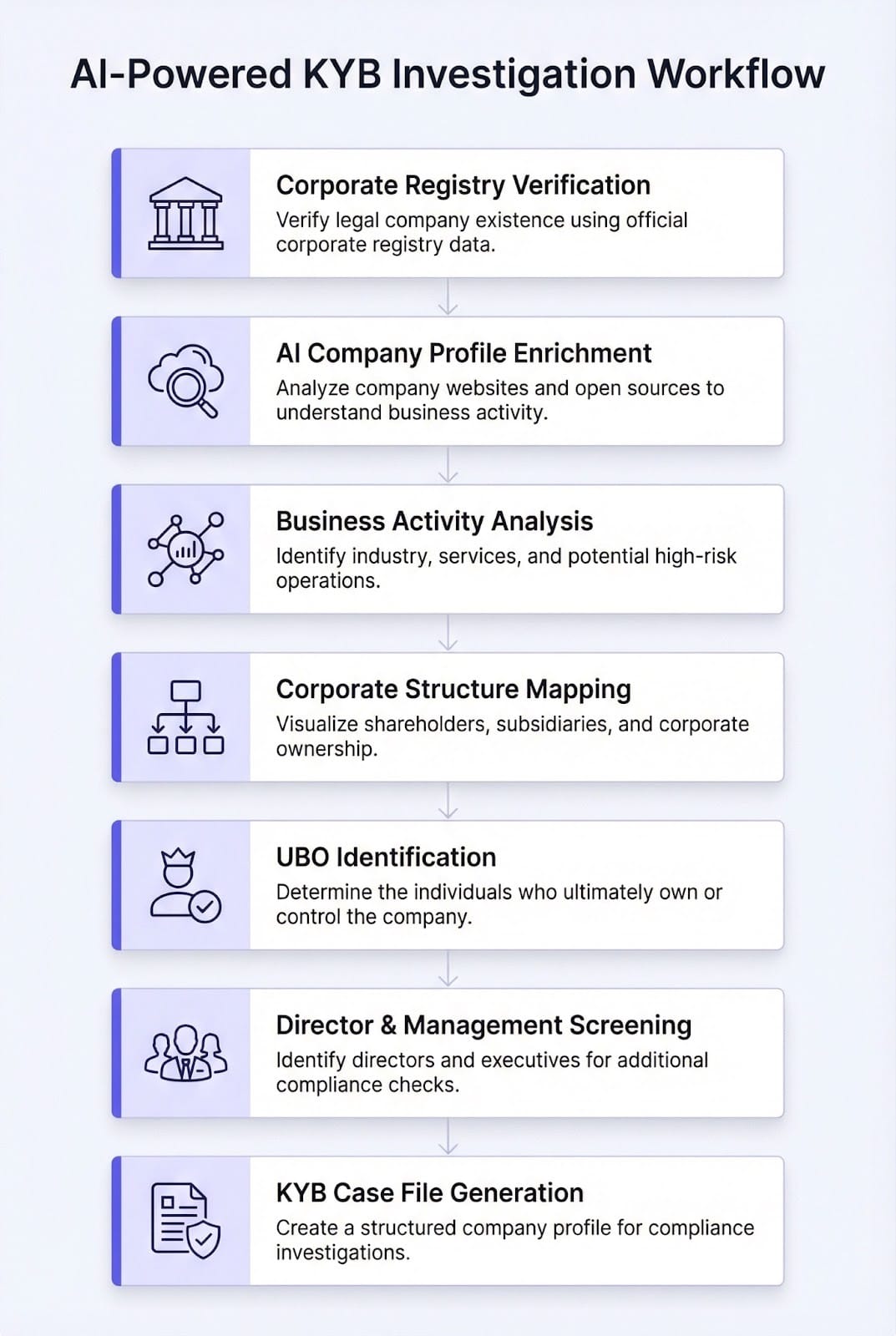
Step 1: Corporate Registry Verification
The first step in any KYB investigation is confirming that the company exists as a legally registered entity. This is typically done through corporate registries and official government databases that maintain records of registered businesses.
The Business Analysis AI Agent automatically retrieves and structures this information directly from third-party corporate registry sources. Instead of searching multiple national databases manually, compliance teams receive verified registry data within a single case file.
The agent extracts key legal attributes that define the company’s official identity. These typically include the legal name of the entity, registration number, jurisdiction of incorporation, legal form, incorporation date, and the current company status. Together, these fields confirm whether the organization is active, dissolved, or otherwise inactive.
Having this verified registry information at the start of the investigation reduces the risk of reviewing the wrong entity and provides a reliable legal foundation for further analysis.
Corporate registry verification also ensures that all subsequent compliance checks, such as sanctions screening or adverse media analysis, are performed against the correct company record.
Data Sources Used in Business Verification
Business verification typically relies on multiple information sources including corporate registries, company websites, open-source intelligence, and regulatory databases. Combining these sources allows compliance teams to validate legal information, understand business activity, and identify ownership structures.
How do compliance teams verify companies in registries?
Compliance teams verify companies by searching official corporate registries and government business databases. These registries provide legally validated information such as the company’s registration number, legal status, jurisdiction, incorporation date, and registered name. This data confirms that the entity exists and establishes its official legal identity before further compliance checks are performed.
Step 2: AI Enrichment of the Company Profile
Official corporate registries confirm that a company exists, but they rarely explain what the company actually does. Registry records typically contain legal attributes, not operational context. For compliance teams, however, understanding the real activity of a business is essential for risk assessment.
The AI Enrichment function of the Business Analysis AI Agent expands the company profile by analyzing publicly available information from open sources. The system reviews the company’s website, publicly accessible business pages, and other open web sources to extract meaningful descriptions of the organization’s activities.
AI enrichment is particularly valuable when registry data is limited or when companies operate internationally and their activities are not fully described in official records.
Using this information, the agent automatically generates a structured company profile. This profile may include the company’s industry classification, description of products or services, and a summary of its business model. The goal is to provide compliance analysts with a clear explanation of what the organization claims to do and how it operates.
An important aspect of this enrichment process is transparency. Each insight generated by the AI is accompanied by a reference to its source. Compliance teams can review the original source material and validate the information before using it in a due diligence assessment.
This approach combines AI-powered company research with verifiable evidence, helping analysts move faster while maintaining auditability.
How AI helps investigate companies
AI can accelerate company investigations by automatically collecting information from corporate websites and open sources, analyzing business descriptions, and structuring this data into a clear company profile. This allows compliance teams to quickly understand a company’s activities while maintaining traceable links to the original information sources.
Step 3: Understanding the Business Model
Once the company profile has been enriched with open-source information, the next step is evaluating the nature of the company’s business activities. For compliance teams, understanding what a company actually does is a critical part of risk assessment.
Different industries carry different levels of regulatory exposure. Financial services, cryptocurrency platforms, online gambling operators, affiliate marketing networks, and high-risk lending businesses are often subject to stricter compliance requirements and enhanced due diligence procedures. Identifying these activities early in the KYB process allows compliance teams to determine whether additional verification steps are required.
The Business Analysis AI Agent analyzes descriptions of the company’s products, services, and website content to help analysts quickly identify the underlying business model. This allows compliance teams to verify whether the stated activities of the company align with its observed online presence and public information.
Understanding the business model also helps analysts detect inconsistencies or potential red flags before deeper compliance checks are initiated.
Many compliance incidents originate from incomplete understanding of a company’s activities during onboarding. Our analysis of common KYB failures in compliance investigations highlights how gaps in early business analysis can lead to regulatory risks.
Common Risk Signals Identified During Business Analysis
Compliance teams often look for early indicators of potential risk, including:
- companies operating in high-risk industries
- inconsistencies between registry information and website activity
- complex ownership structures across multiple jurisdictions
- companies with limited digital presence or unclear business models
Why understanding business activity matters in KYB
Understanding a company’s business activity allows compliance teams to assess whether the organization operates in a high-risk industry and whether enhanced due diligence may be required. This analysis helps determine regulatory exposure, potential compliance risks, and whether the company’s activities align with its declared business model.
Step 4: Corporate Structure Mapping
Understanding who owns and controls a company is a central part of corporate due diligence. Many organizations operate through layered ownership structures that may include multiple shareholders, holding entities, subsidiaries, and management roles across different jurisdictions. Without a clear visualization of these relationships, compliance teams must manually reconstruct ownership chains from registry documents and filings.
The Business Analysis AI Agent automatically builds a corporate structure map that presents these relationships in a clear, visual format. The system aggregates registry information and organizational data to construct an ownership graph that shows how different entities and individuals are connected to the company under review.
Within this structure, compliance analysts can quickly identify shareholders, parent companies, subsidiaries, and key management roles such as directors or executives. Each node in the structure represents either a legal entity or an associated individual, allowing investigators to see how ownership and control are distributed across the organization.
This structured visualization simplifies complex corporate hierarchies and enables analysts to quickly determine where decision-making power and ownership influence reside.
How ownership structures are identified in KYB
Ownership structures in KYB investigations are typically identified by analyzing corporate registry records, shareholder disclosures, and company filings. Compliance teams examine these sources to determine how shares are distributed, which entities act as parent companies or subsidiaries, and which individuals ultimately control the organization. AI systems can automate this process by collecting registry data and constructing ownership graphs that visualize these relationships.
Step 5: Identifying Ultimate Beneficial Owners
One of the most important tasks in corporate due diligence is identifying the ultimate beneficial owners (UBOs) of a company. While corporate registries often list shareholders or legal owners, the individuals who ultimately control the organization may be hidden behind multiple layers of companies or nominee structures.
The Business Analysis AI Agent analyzes ownership information collected from corporate registries and corporate structure data to determine where control of the organization resides. By examining ownership percentages, control relationships, and shareholder chains, the system helps compliance teams identify individuals who ultimately benefit from or control the company.
Each identified beneficial owner is displayed within the corporate structure along with their role and relationship to the entity under investigation. This allows analysts to quickly understand how control is distributed across the organization and where further compliance checks should be focused.
Once beneficial owners are identified, they can be passed to additional screening modules such as sanctions checks, PEP screening, and adverse media monitoring.
What is a UBO in KYB?
A UBO (Ultimate Beneficial Owner) is the individual who ultimately owns or controls a company, either directly through share ownership or indirectly through a chain of entities. Identifying UBOs is a core requirement of anti-money laundering regulations and is essential for understanding who ultimately benefits from a business relationship.
Step 6: Directors and Management Analysis
In addition to identifying beneficial owners, compliance investigations must also examine the individuals responsible for managing the company. Directors, executives, and senior managers can significantly influence how a business operates and may expose the organization to regulatory or reputational risk.
The Business Analysis AI Agent automatically identifies key management roles associated with the company. This typically includes directors, chief executive officers, board members, and other senior executives listed in corporate registries or official filings. These individuals are then linked to the company profile within the investigation workspace.
By identifying management roles early in the KYB process, compliance teams can determine which individuals should undergo additional background checks. Once identified, directors and executives can be passed to further screening modules such as sanctions screening, PEP checks, adverse media monitoring, and digital footprint analysis.
This ensures that both the ownership and leadership of the organization are reviewed as part of the overall due diligence process.
Why directors must be screened in KYB
Directors and senior managers must be screened during KYB because they have operational control over the company. Even if ownership appears legitimate, individuals managing the organization may be associated with sanctions exposure, political positions, financial crime investigations, or other compliance risks that require further review.
Person Analysis AI Agent
While the Business Analysis agent focuses on understanding the company as a legal entity, compliance investigations also require detailed analysis of the individuals connected to that organization. Directors, beneficial owners, and senior managers must often undergo additional background checks as part of KYB and KYC procedures.
For this purpose, Scoreplex provides a dedicated Person Analysis AI Agent designed specifically for investigating individuals associated with corporate entities. Once key people are identified within the company structure, they can be transferred directly into this module for further analysis.
Organizations increasingly build specialized agents for different compliance tasks, including corporate investigations, identity verification, and screening workflows. These approaches are explored in our guide to building AI compliance agents for KYB and KYC automation.
The Person Analysis agent includes multiple verification and screening capabilities. These typically include identity verification, sanctions screening, politically exposed person (PEP) checks, adverse media analysis, and digital footprint investigation across publicly available sources.
Together, these tools allow compliance teams to build a complete risk profile not only for the company, but also for the individuals who own or manage it.
How companies screen individuals during KYB
During KYB investigations, individuals connected to a company such as directors, shareholders, and beneficial owners are screened using KYC procedures. This typically includes identity verification, sanctions and PEP screening, adverse media analysis, and investigation of public digital footprints to assess potential compliance risks.
From Data Collection to a Complete KYB Case File
By combining registry verification, AI enrichment, and corporate structure analysis, the Business Analysis AI Agent transforms fragmented company information into a structured KYB case file.
Instead of manually collecting documents and assembling investigation notes, compliance teams receive a consolidated company profile within a single workspace. All relevant corporate intelligence is organized and linked to its original sources, allowing analysts to review findings quickly and maintain a clear audit trail.
A typical KYB case file generated through this process includes verified corporate registry data, a structured company profile derived from open sources, a mapped corporate ownership structure, identified ultimate beneficial owners, and the list of directors and key management personnel associated with the organization.
Having this information in a single investigation record allows compliance teams to move directly into the next stages of due diligence, such as sanctions screening, adverse media monitoring, and enhanced risk assessment.
What should be included in a KYB report?
A KYB report typically includes verified corporate registry information, a description of the company’s business activities, details of its ownership structure, identification of ultimate beneficial owners, and information about directors or senior managers connected to the organization. This information forms the foundation for assessing potential compliance risks before establishing a business relationship.
Why This Matters for Compliance Teams
Corporate due diligence has traditionally been a fragmented and time-intensive process. Compliance analysts often rely on multiple data providers, open-source searches, and manual documentation to build a complete picture of a company. This approach slows onboarding, increases operational costs, and introduces inconsistencies in how investigations are conducted.
The growing adoption of AI in regulatory operations is driven by the need to reduce manual work and accelerate onboarding. Our detailed research in the AI in compliance operations whitepaper explores how automation is transforming KYB and KYC workflows.
The Business Analysis AI Agent addresses these challenges by automating the initial stage of KYB investigations. Instead of switching between tools and manually compiling company information, compliance teams receive a structured investigation environment that aggregates registry data, open-source intelligence, and ownership information in one place.
This reduces the time required to prepare a company profile and allows analysts to focus on evaluating risk rather than gathering data. By standardizing the way company investigations are performed, AI-driven KYB workflows help compliance teams accelerate onboarding while maintaining traceability and documentation for regulatory audits.
Conclusion
Business verification is the foundation of every KYB investigation. Before sanctions screening, adverse media analysis, or risk scoring can begin, compliance teams must first understand the company they are dealing with: its legal status, business activities, ownership structure, and the individuals who control it.
The Business Analysis AI Agent by Scoreplex automates this critical stage of corporate due diligence. By combining corporate registry data, AI-powered open-source enrichment, and ownership structure mapping, the system builds a structured company profile that becomes the starting point of the entire KYB workflow.
Instead of fragmented manual research, compliance teams gain a clear and organized view of corporate intelligence within a single investigation environment.
Frequently Asked Questions
What is business verification in KYB?
Business verification in KYB (Know Your Business) is the process of confirming that a company legally exists and understanding how it operates before establishing a business relationship. Compliance teams verify company registration data, analyze ownership structures, identify ultimate beneficial owners (UBOs), and review the company’s business activities. This process helps financial institutions and regulated businesses assess potential compliance risks before onboarding a corporate client.
How do compliance teams investigate companies?
Compliance teams investigate companies by combining information from corporate registries, company websites, regulatory databases, and open-source intelligence. Analysts typically verify legal registration details, analyze ownership structures, identify directors and beneficial owners, and review the company’s business model. These steps help ensure that the organization is legitimate and that its activities do not present regulatory or financial crime risks.
What information is needed for KYB verification?
KYB verification typically requires several types of information about a company. This includes official registry data such as the company’s legal name, registration number, jurisdiction, and legal status. Compliance teams also review the company’s business activities, ownership structure, ultimate beneficial owners, and the identities of directors or senior managers. Together, this information forms the basis of a corporate due diligence assessment.
How are UBOs identified in corporate investigations?
Ultimate Beneficial Owners (UBOs) are identified by analyzing corporate ownership structures and shareholder records. Compliance teams review registry data, company filings, and ownership chains to determine which individuals ultimately control or benefit from the organization. In complex corporate structures, UBOs may be identified by tracing ownership across multiple entities until the individuals with controlling interest or influence are revealed.
How AI helps automate corporate due diligence?
AI can automate many parts of corporate due diligence by collecting company data from corporate registries, analyzing open-source information, mapping ownership structures, and identifying beneficial owners. AI systems can also generate structured company profiles and KYB case files, allowing compliance teams to focus on risk analysis rather than manual data collection. This significantly accelerates the business verification process and improves consistency in compliance investigations.
These questions reflect some of the most common topics compliance teams explore when conducting business verification and KYB investigations.
About Scoreplex
Scoreplex KYB AI-Coworker is an AI-powered KYB workflow that assembles a standardized, audit-ready case file end-to-end, from business identity and digital footprint to documents and a final due diligence narrative.
It builds a structured company baseline, consolidates web presence into a single evidence pack, and manages documents and questionnaires with clear statuses and traceable source links.
Registry, UBO, sanctions & PEP: Enriches the baseline with registry data, maps ownership and control to identify UBOs and related parties, and runs sanctions/PEP screening with evidence-linked sources.
Web presence check: Normalizes website, domain, social, third-party profile, and review signals into consistent categories with source links.
Document verification: Extracts KYB fields via OCR/NLP, cross-checks against documents, registries (where available), and questionnaires, and returns an exception list of gaps and mismatches.
Adverse media analysis: Collects broadly, deduplicates and ranks results, reduces name-collision noise, and clusters coverage into risk-labeled events with evidence-linked sources.
Due diligence narrative: Generates an AI-drafted, report-ready narrative that explains the risk outcome and cites the evidence trail.
AI agent constructor: Lets teams configure workflows, checks, and outputs to their needs while preserving an audit-ready trail.
The output is one consistent case file per counterparty, reducing manual assembly and speeding reviews by focusing analysts on exceptions rather than collection.