
Company analysis in KYB is still a manual investigation disguised as a process. Teams jump between registries, websites, and internal tools, trying to piece together a coherent picture of a business before they can even start risk assessment.
This slows down onboarding, increases operational cost, and creates blind spots. When analysis takes hours or days, compliance becomes a bottleneck for growth, not a safeguard.
Scoreplex Business Analysis AI Agent automates this step end-to-end. It collects, structures, and verifies company data across sources in a single workflow, without relying on fragmented tools or manual effort.
The result is a complete, structured company profile in minutes, ready for the next stages of KYB and built on verifiable, evidence-linked data.
What this AI Agent does
The Business Analysis AI Agent is the starting point of the KYB process. It builds a structured understanding of a company before any risk checks begin.
Instead of manually gathering data from registries, websites, and scattered sources, the agent automatically collects and organizes this information into a single profile. It identifies the legal entity, extracts corporate data, analyzes business activity, and maps ownership structure.
This creates a reliable foundation for the rest of the compliance workflow. Every next step — from sanctions screening to risk assessment — depends on the quality of this initial analysis.
Scoreplex Business Analysis AI Agent
In the demo below, you’ll see how the Business Analysis AI Agent builds a complete company profile in real time.
Pay attention to how data is pulled from multiple sources and immediately structured into a clear, usable format. Instead of raw data or disconnected outputs, the system produces a coherent view of the company: who they are, what they do, and how they are structured.
By the end of the flow, you’re looking at a ready-to-use foundation for the entire KYB process.
How the Business Analysis AI Agent works
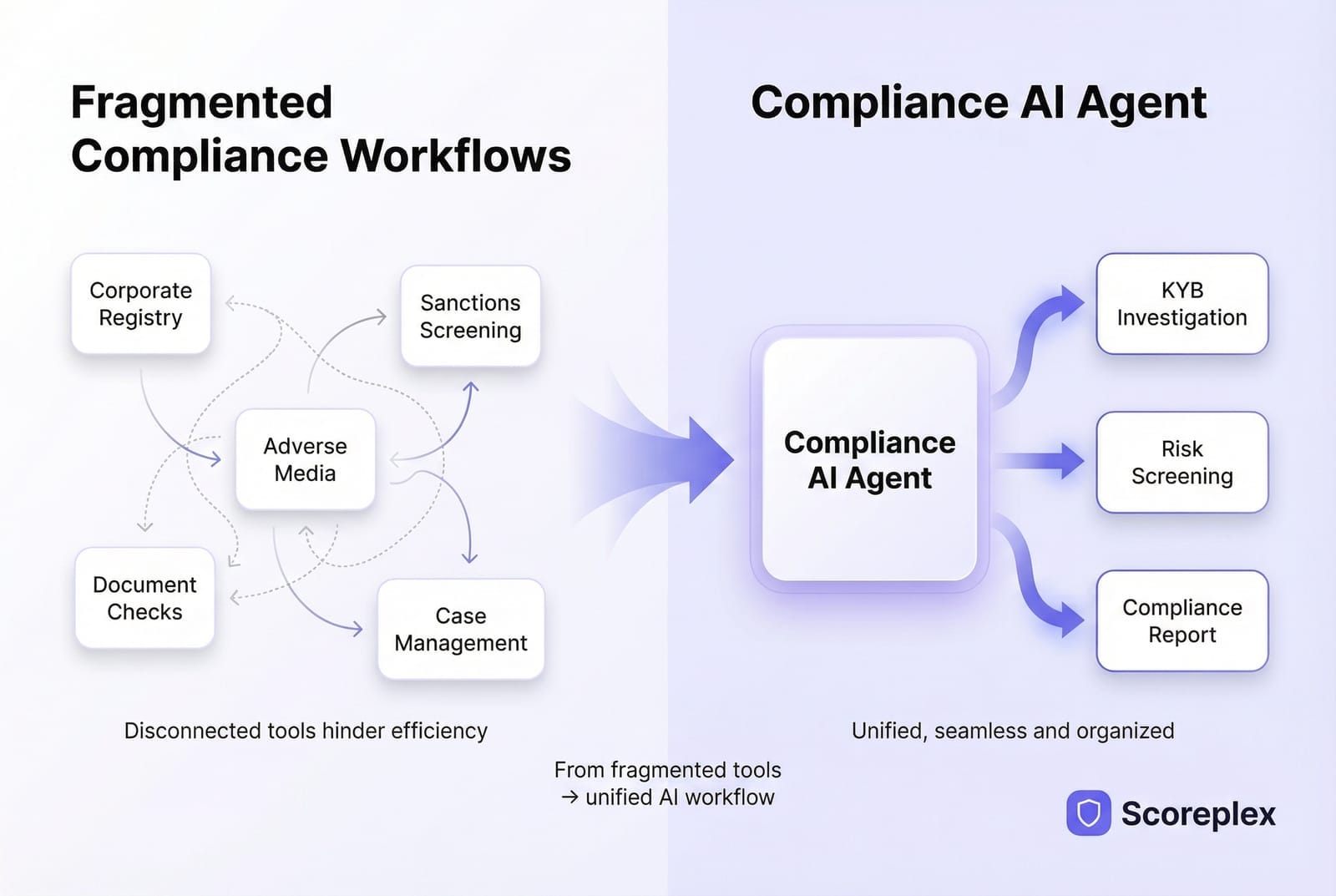
The Business Analysis AI Agent replaces a fragmented, manual investigation with a single structured workflow. Instead of switching between tools and sources, the system builds a complete company profile step by step.
Company identification and registry data
The process starts with identifying the legal entity and extracting official registry data. The agent pulls core attributes such as registration number, legal form, incorporation date, status, jurisdiction, and industry classification.
This data is normalized and structured automatically, removing inconsistencies that typically appear when analysts collect it manually across different registries.
As a result, you get a clean, reliable baseline of the company without spending time validating formats or cross-checking fields.
Company profile from website
Next, the agent analyzes the company’s website to understand what the business actually does.
It extracts key signals about products, services, target markets, and operational focus. This step is critical because registry data alone rarely reflects real activity.
The system also highlights potential risk indicators such as high-risk industries, unclear business models, or mismatches between declared and actual activity.
Instead of reading through pages manually, you get a concise, structured summary of the company’s operations.
Ownership and UBO mapping
The agent then reconstructs the ownership structure, identifying shareholders, key managers, and ultimate beneficial owners.
It maps relationships between entities and individuals, creating a clear view of who controls the business.
This eliminates one of the most time-consuming parts of KYB, where analysts typically piece together ownership chains from multiple documents and sources.
The output is a structured ownership graph that can be used directly in further checks.
Address verification
The system verifies the company’s registered address using external mapping sources.
It compares the address from official documents with real-world location data and provides visual confirmation through map and street-level views.
This helps detect inconsistencies, shell entities, or non-existent locations without requiring manual checks.
What makes Scoreplex different
Most KYB tools don’t actually solve the core problem. They give access to data, dashboards, or screening results, but the analysis itself still depends on manual work.
Scoreplex takes a different approach. It doesn’t add another tool to the stack — it replaces the investigation workflow with an AI agent that produces a structured, explainable outcome.
Evidence-linked analysis
Every piece of information in the company profile is tied to a specific source.
Instead of black-box outputs or generic summaries, you can trace each data point back to where it came from — whether it’s a registry, a website, or an external dataset.
This makes the analysis auditable and defensible, which is critical in regulated environments.
No hallucinations approach
The system is designed so that AI does not generate or “invent” data.
All primary information is collected through structured data pipelines and OSINT-based enrichment. The AI layer is used only to interpret, organize, and present this data in a usable format.
This significantly reduces the risk of false or misleading outputs and keeps the analysis grounded in verifiable evidence.
One workflow instead of multiple tools
Traditional KYB requires switching between registries, screening tools, search engines, and internal systems.
Scoreplex consolidates these steps into a single workflow. Company data, website analysis, ownership structure, and operational signals are all processed together and presented in one place.
This removes the need to stitch together fragmented outputs and dramatically reduces manual effort.
Built as a foundation for full KYB
Business analysis is not an isolated task — it is the foundation for everything that follows.
Scoreplex structures company data in a way that directly feeds into sanctions screening, adverse media analysis, and overall risk assessment. The system already understands the entity, its structure, and its context.
This eliminates rework and ensures consistency across the entire KYB process.
What you get as output
The result of the Business Analysis AI Agent is not raw data or fragmented findings. It is a complete, structured understanding of the company, ready to be used immediately in the KYB process.
You get a clean company profile that combines registry data, business activity, and operational signals in a single view. Ownership is mapped into a clear structure, showing shareholders, managers, and ultimate beneficial owners without requiring manual reconstruction.
The registered address is verified against real-world data, reducing uncertainty around physical presence. Contact and activity signals are already integrated, giving additional context on whether the business is active and reachable.
Instead of assembling reports from multiple sources, you start with a ready-to-use foundation. The output is structured, consistent, and directly usable for further checks and decision-making.
Use cases
The Business Analysis AI Agent is most valuable in environments where company verification is frequent, complex, and directly impacts revenue.
Banks and fintechs
It reduces the time required to understand a business client before approval. Instead of analysts manually collecting and validating company data, the agent produces a structured profile in minutes, allowing teams to move faster without sacrificing control.
Crypto and other high-risk industries
In this case, counterparties often operate across jurisdictions and have limited transparency, the agent helps uncover real business activity and ownership structure. This reduces reliance on incomplete registry data and lowers the risk of onboarding problematic entities.
Marketplaces and platforms
It enables scalable vendor and merchant verification. Rather than building KYB processes around manual review, platforms can standardize company analysis and onboard partners faster while maintaining compliance.
Supplier and counterparty due diligence
The agent provides a consistent way to assess business partners across regions. This is especially important in cross-border operations, where data quality and formats vary significantly.
Business impact
The impact of automating business analysis is not isolated to one step — it affects the entire KYB pipeline.
First, onboarding speed increases. When the initial company analysis takes minutes instead of hours, the overall time to onboard a business client drops significantly.
Second, manual workload is reduced. Analysts no longer spend time gathering, formatting, and cross-checking basic company data, which frees capacity for higher-risk investigations.
Third, consistency improves. Structured, system-driven analysis removes variability between analysts and reduces errors caused by fragmented data collection.
Finally, downstream processes become more efficient. When sanctions screening, adverse media checks, and risk assessment start with a clean, verified company profile, false positives decrease and decisions become faster and more reliable.
Business analysis stops being a bottleneck and becomes a force multiplier for the entire compliance workflow.
About Scoreplex
Scoreplex is a KYB AI-coworker that automates customer due diligence, minimizes false positives, streamlines document verification, and generates comprehensive narrative reports.
How it works:From a single company input, it produces a complete business risk profile, including::
- Official registry checks with UBO identification and full ownership chains
- Global sanctions and PEP screening
- Real-time adverse media monitoring with structured events and source attribution
- Automated document verification (incorporation records, address validation)
- Website analysis and cross-checks of company details, products, contacts, and locations
- Product and customer review analysis (Trustpilot, G2, Google Reviews)
- Social media analysis of corporate accounts and profiles of founders and directors
- High-risk country exposure assessment based on aggregated signals
- A structured risk summary highlighting red flags, rationale, and direct source links
Built for Faster, Smarter KYB Decisions:
- 10× faster KYB reviews through end-to-end automation
- Up to 10× lower costs compared to traditional KYB service providers
- Significantly fewer false positives driven by registry-first matching and transparent risk signals