
Compliance operations have shifted from a regulatory requirement to an operational constraint. For fintech platforms, banks, crypto exchanges, marketplaces, and cross-border operators, onboarding customers, reviewing alerts, conducting due diligence, and documenting decisions often stall in repetitive data gathering, screening analysis, ownership tracing, and case reporting. As volumes grow, the constraint becomes structural rather than procedural.
We have previously examined how AI compliance agents can be configured and governed in production environments in our detailed breakdown of AI compliance agent architecture.
AI in compliance is rapidly moving from experimental tooling to operational infrastructure. From AI compliance software used in onboarding to regulatory compliance AI systems automating screening and adjudication, organizations are restructuring how compliance functions operate. The convergence of AI and compliance is no longer theoretical — it is becoming a structural shift in how regulated institutions manage risk.
A new category of systems has formed around this pressure: AI agents for compliance. These products claim to execute defined compliance tasks, assemble case files, apply policy logic, and escalate exceptions with structured context. The term is widely used. Its meaning varies.
This review examines ten products positioned as AI agents in modern compliance operations, with a strong focus on business onboarding and due diligence workflows. Before evaluating them individually, it is necessary to define what qualifies as an agent, how agent maturity differs across vendors, and where these systems create measurable operational impact.
What Qualifies as a Compliance AI Agent
In compliance software, AI can appear in many forms. Not all represent agentic systems.
For the purpose of this analysis, a product qualifies as a compliance AI agent if it demonstrates most of the following characteristics:
- It executes defined compliance tasks autonomously, rather than merely surfacing data.
- It controls part of the workflow, not just a single analytical output.
- It operates within explicit policy boundaries, including escalation logic.
- It produces structured, reviewable case outputs suitable for audit and governance.
Under this definition, there is a meaningful difference between enrichment tools, workflow automation platforms, and systems capable of adjudicating alerts or onboarding outcomes.
Agent Maturity Framework
To evaluate the products consistently, this review uses a four-level maturity model:
Level 1 – Analytical Tool
The system analyzes or enriches data but does not control workflow or decision flow.
Level 2 – Task Automation Agent
The system autonomously executes specific tasks, such as document extraction or alert summarization, within a broader human-controlled process.
Level 3 – Case Builder Agent
The system assembles structured case files, applies policy logic, drafts narratives, and routes cases for approval.
Level 4 – Autonomous Adjudication Agent
The system can approve or reject defined categories of cases within policy boundaries, escalating only exceptions to humans.
Most products in the market operate between Levels 2 and 3. A smaller subset approaches Level 4 under controlled governance models.
This distinction is operationally significant. The higher the autonomy, the greater the dependency on policy clarity, audit controls, and risk appetite alignment.
Data Points: AI and Compliance — Market Growth and Adoption
Artificial intelligence is rapidly reshaping compliance and regulatory operations across industries, with measurable market size growth and widespread adoption trends:
- The global legal and compliance AI market — which includes AI systems designed to automate regulatory workflows, risk detection, and governance tasks — was valued at approximately USD 35.97 billion in 2025 and is projected to grow at a 36.3 % compound annual growth rate (CAGR) through 2033. This expansion reflects increasing investment in AI-based compliance technology across sectors.
- A related segment, the AI for security compliance market, is forecast to expand from about USD 282.8 million in 2026 to roughly USD 1.69 billion by 2035 at a 22 % CAGR, driven by rising regulatory requirements and digital transformation pressures.
- Broad enterprise adoption of AI is accelerating: one global AI adoption survey found that 64 % of respondents reported that AI enables innovation and cost or efficiency benefits, indicating that compliance use cases — where risk and accountability matter most — are part of mainstream AI strategy discussions.
- Across finance and regulated sectors, AI systems are increasingly embedded into risk and compliance processes. By 2025, 84 % of finance teams reported relying on AI tools for operational tasks, including predictive monitoring and regulatory adaptation.
These indicators highlight how AI compliance software and regulatory compliance AI solutions are not niche experiments, but core infrastructure, with clear growth trajectories, strategic adoption, and measurable operational impact.
Where Compliance AI Agents Deliver Operational Value
Compliance friction tends to accumulate in specific lifecycle stages, particularly in business onboarding, alert review, due diligence, and ongoing monitoring. AI agents concentrate value in one or more of the following areas:
Data consolidation
Corporate registry fragmentation and inconsistent formats create repetitive research overhead.
Ownership mapping
Layered shareholding structures and beneficial ownership chains require structured entity resolution.
Screening adjudication
Sanctions and PEP screening generate high volumes of matches that demand repetitive analysis.
Case documentation
Compliance reporting requires consistent narratives and evidence linking.
Ongoing monitoring
Periodic reviews introduce recurring workload across large customer portfolios.
Different agents target different bottlenecks. Some focus on ownership intelligence. Others prioritize false positive reduction. Others optimize investigation throughput. Comparing vendors without understanding this specialization leads to misleading conclusions.
Real-world enforcement cases show how structural weaknesses in compliance design lead to failure, as discussed in our analysis of recent KYB breakdowns.
Methodology and Scope
The products included in this review publicly position themselves as AI agents or agentic compliance systems relevant to compliance workflows. The analysis is based on publicly available product documentation, architectural descriptions, feature disclosures, and, where available, third-party review platforms.
Several constraints apply:
- Public detail varies across vendors.
- Third-party reviews are unevenly distributed.
- Performance claims reflect vendor disclosures unless independently validated.
The objective is to provide a structured evaluation framework, not promotional ranking. Each product is examined using consistent criteria to clarify architectural focus, autonomy level, and practical tradeoffs.
#1 Scoreplex

Scoreplex operates as an AI compliance software platform focused on business due diligence and structured onboarding workflows. It applies AI in compliance operations to assemble unified case files, perform risk screening, and generate audit-ready summaries within defined policy boundaries.
What the agent does
- Business verification and enrichment: collects and structures legal entity data, registration details, jurisdiction facts, and company profile information.
- Ownership and control mapping: identifies UBOs, shareholders, directors, and maps control relationships into a structured corporate view.
- Risk screening: runs PEP, sanctions, and adverse media checks with confidence scoring and source references.
- Digital footprint analysis: evaluates website presence, social signals, and generates a web presence score to support risk assessment.
- Case drafting and workflow: compiles findings into a single case file with an AI written compliance summary and structured due diligence checklist.
Agent maturity level
Level 3: Autonomous case preparation with human adjudication.
The agent autonomously gathers evidence, performs screenings, and drafts the compliance narrative, while final approval and risk acceptance remain with a human reviewer.
Strengths
- Evidence linked reporting that improves auditability and reduces subjective interpretation.
- End to end coverage across company data, ownership, sanctions, media, and digital footprint in one workflow.
- Operational efficiency focus, designed to cut manual preparation time and reduce false positives in screening.
Limitations and tradeoffs
- Jurisdiction dependent data depth, especially for ownership transparency and registry access.
- Policy customization may be required to align outputs with specific regulatory expectations or internal risk appetite.
- Complex edge cases still require analyst review, particularly for layered ownership structures or high risk industries.
Best use cases
- Fintech, crypto, and lending platforms onboarding SMEs at scale.
- Cross border trade and supply chain counterparty checks.
- Compliance teams seeking faster case preparation with structured audit ready outputs.
Who it is not for
Organizations that only need a narrow point solution, such as standalone sanctions screening without full compliance case orchestration.
Final take
Scoreplex positions itself as a practical compliance AI agent for teams that want to transform fragmented due diligence tasks into a unified, evidence backed case file with measurable efficiency gains.
#2 spektr

spektr applies AI for compliance with a strong emphasis on ownership intelligence and entity resolution. Its compliance AI architecture concentrates on structuring fragmented corporate data and mapping UBO relationships across jurisdictions.
What the agent does
- Business data aggregation and enrichment: pulls corporate registry information and consolidates fragmented company data into a unified profile.
- Ownership and UBO resolution: uses AI to identify beneficial owners and map ownership structures across jurisdictions.
- Sanctions, PEP, and adverse media screening: integrates risk checks into the compliance workflow with structured outputs.
- Workflow orchestration: allows teams to configure compliance processes and automate case progression.
- Ongoing monitoring: supports continued risk checks and updates after initial onboarding.
Agent maturity level
Level 2 to Level 3: Semi autonomous compliance automation.
spektr automates data collection, structuring, and screening, while compliance teams remain actively involved in review and decision making. The system acts as an intelligent case builder rather than a fully autonomous adjudicator.
Strengths
- Strong focus on ownership intelligence, particularly useful in complex or cross border corporate structures.
- Workflow flexibility, allowing teams to tailor compliance processes to internal policies.
- Clear positioning around AI driven entity resolution, addressing one of the most time consuming parts of compliance.
Limitations and tradeoffs
- Dependence on external data sources, meaning depth and coverage vary by jurisdiction.
- Full autonomy is limited, as final decisioning remains human led.
- Advanced customization may require configuration effort, especially for larger organizations.
Best use cases
- Fintechs onboarding companies with layered ownership structures.
- Cross border compliance teams needing better UBO visibility.
- Organizations looking to modernize compliance workflows without replacing all existing systems.
Who it is not for
Companies seeking a plug and play fully autonomous compliance decision engine with minimal human oversight.
Final take
spektr stands out for its ownership intelligence and structured workflow automation, making it particularly relevant for compliance teams dealing with complex corporate structures. It operates best as an AI assisted case builder that enhances human decision making rather than replacing it.
#3 Dotfile Autonomy

Dotfile Autonomy delivers regulatory compliance AI designed to autonomously review routine cases and escalate exceptions. It represents a more advanced implementation of AI for regulatory compliance, embedding decision logic directly into onboarding workflows.
What the agent does
- Autonomous compliance case review and decisioning: automates routine compliance checks and can approve low risk cases while escalating exceptions to human reviewers.
- Audit transparent case output: emphasizes full auditability and regulatory oversight for agent decisions and handoffs.
- False positive reduction: designed to reduce screening noise and repetitive manual reviews.
- End to end compliance platform foundation: operates on top of a broader compliance stack including UBO discovery, AML screening, document analysis, risk scoring, and case management.
- Exception routing with context: escalates complex cases to humans with structured findings and supporting evidence.
Agent maturity level
Level 3 to Level 4: Autonomous case processing with controlled escalation.
Dotfile frames Autonomy as self decisioning for compliance case reviews, automatically approving straightforward cases and escalating edge cases, placing it closer to autonomous adjudication than a typical assistant model.
Strengths
- High autonomy focus, targeting routine case review and false positive heavy workflows.
- Strong emphasis on auditability and oversight, critical for regulated environments.
- Integrated within a full compliance stack, enabling continuity from data collection to decisioning.
Limitations and tradeoffs
- Autonomy requires clearly defined internal policies and thresholds to align with regulatory expectations.
- Complex or high risk cases still depend on human review, limiting speed gains in edge heavy portfolios.
- Performance improvements depend on actual case mix, which should be validated in pilot environments.
Best use cases
- High volume compliance onboarding with a large share of routine, low risk cases.
- Compliance teams overloaded with screening alerts and repetitive reviews.
- Regulated organizations seeking automation with traceable, explainable decisions.
Who it is not for
Organizations that mandate manual approval for nearly all compliance cases regardless of risk profile.
Final take
Dotfile Autonomy represents a more aggressive interpretation of agent based compliance automation, aiming to decide rather than simply assist. It is strongest in routine heavy pipelines where autonomous approval can safely replace repetitive human review, provided governance and policy controls are well defined.
#4 Parcha

Parcha implements AI-based compliance automation to streamline document collection, verification steps, and structured case progression. The platform integrates AI in compliance workflows while keeping final adjudication within human control.
What the agent does
- Business verification automation: collects and verifies company information across registries and structured data sources.
- Document collection and analysis: automates outreach for required documents and extracts structured data from submitted files.
- Sanctions, PEP, and risk screening: integrates screening checks directly into the compliance process.
- Workflow orchestration: allows teams to configure task based verification flows and automate case progression.
- Case management support: centralizes findings and maintains structured compliance records.
Agent maturity level
Level 2 to Level 3: Semi autonomous task execution within defined workflows.
Parcha’s agents automate discrete verification steps and structured workflows, while final decisioning and complex edge case analysis remain with compliance teams.
Strengths
- Strong workflow configurability, enabling teams to tailor compliance processes to internal SOPs.
- Focus on document driven verification, reducing manual back and forth with counterparties.
- Operational clarity, designed to streamline repetitive compliance tasks.
Limitations and tradeoffs
- Autonomy is task oriented rather than full case adjudication, so human oversight remains central.
- Depth of registry coverage varies by jurisdiction, affecting completeness in complex cross border cases.
- Advanced customization may require implementation effort, especially in larger enterprises.
Best use cases
- Fintechs and platforms onboarding SMEs that require structured document collection.
- Compliance teams seeking automation of repetitive verification tasks.
- Organizations modernizing manual compliance workflows without fully replacing internal decision logic.
Who it is not for
Organizations looking for a fully autonomous compliance decision engine that independently approves or rejects cases end to end.
Final take
Parcha operates best as a configurable compliance task agent embedded in structured workflows. It enhances operational efficiency and document handling, while keeping final risk judgment within the compliance team’s control.
#5 Arva AI
Arva AI positions itself at the intersection of AI and compliance operations, functioning as an AI-driven compliance workforce that assists with investigations, onboarding reviews, and structured case drafting.
What the agent does
- Compliance onboarding support: collects and structures business information needed for onboarding and periodic reviews.
- Risk screening workflows: runs sanctions and PEP style checks and helps triage potential matches into actionable case outputs.
- Enhanced due diligence assistance: builds EDD style summaries by aggregating signals across sources and packaging them for review.
- Ongoing monitoring support: helps track changes and new risk signals after onboarding to reduce manual re-check work.
- Case file drafting: produces structured writeups that standardize how analysts document decisions and supporting evidence.
Agent maturity level
Level 2 to Level 3: Semi autonomous case work with human adjudication.
Arva’s framing is closer to “AI analysts” executing tasks and producing ready to review case materials, while final decisions and high risk calls remain with humans.
Strengths
- Workforce framing that maps cleanly onto real compliance operations (triage, investigation, writeup, escalation).
- Good fit for throughput problems, where analyst time is the constraint and standardization matters.
- Broad applicability across compliance and EDD, useful when you want one agent layer across multiple fincrime workflows.
Limitations and tradeoffs
- Outcome quality depends on governance: you need clear policies, escalation rules, and reviewer oversight to keep decisions consistent.
- Not a pure compliance only product: if you want deep registry enrichment and ownership graphing as the core differentiator, you may need complementary tooling.
- Edge cases still require experienced analysts, especially for complex ownership, ambiguous entity resolution, and high risk sectors.
Best use cases
- Compliance teams that need to scale analyst capacity without hiring at the same pace.
- Programs with heavy alert triage and repetitive case writeups across compliance and EDD.
- Fast growing fintechs that want standardized case documentation and quicker turnaround.
Who it is not for
Teams that only need a narrow point tool for a single check and do not want an agent layer touching case workflows.
Final take
Arva AI is best understood as an AI agent workforce that produces review ready compliance work products and reduces analyst load. It is strongest where consistency, triage speed, and scalable operations matter more than bespoke, edge case heavy investigative depth.
#6 Sardine

Sardine deploys AI in compliance and fraud workflows as part of a broader risk orchestration layer. Its compliance AI capabilities focus on real-time decision support across onboarding and ongoing monitoring processes.
What the agent does
- Onboarding automation: supports KYC and KYB style onboarding flows with decisioning signals and workflow routing.
- Risk screening and alert handling: helps triage screening style matches and operationalizes review steps into cases.
- Fraud plus compliance orchestration: connects fraud signals with compliance workflows so teams can act on a single risk view.
- Ongoing monitoring support: helps track new risk signals over time and route updates into reviews.
- Case workflow outputs: packages findings into reviewable outputs that teams can approve, escalate, or investigate further.
Agent maturity level
Level 2 to Level 3: Semi autonomous risk operations with human adjudication.
Sardine’s agent framing is strongest around automating operational steps and decision support, while final approvals and higher risk judgments typically remain with humans.
Strengths
- Unified risk view across onboarding, fraud, and compliance, which reduces tool fragmentation.
- Operational throughput focus, built for high volume pipelines and fast decisions.
- Strong fit for real time workflows, where you need continuous risk signals, not just a one time compliance snapshot.
Limitations and tradeoffs
- Compliance depth may be less “registry first” than specialist compliance tools, depending on your needs for ownership mapping and jurisdiction specific registry detail.
- Implementation and tuning effort can be meaningful because value depends on thresholds, routing, and policy alignment.
- Less ideal for narrative heavy compliance if your process requires long form, evidence linked case reports as the primary deliverable.
Best use cases
- High volume fintech onboarding where fraud and compliance decisions must work together.
- Teams that need continuous monitoring and fast operational routing, not only onboarding checks.
- Organizations consolidating multiple risk tools into one workflow oriented platform.
Who it is not for
Companies looking for a compliance only specialist focused mainly on deep registry enrichment and complex ownership graphing.
Final take
Sardine is a strong pick when compliance is part of a broader risk machine and you want agent style automation to keep onboarding fast while monitoring risk continuously. It is less compelling if your main pain is deep corporate structure analysis and jurisdiction specific registry completeness.
#7 SphinxHQ
SphinxHQ delivers AI compliance automation by transforming scattered signals into structured compliance cases. The system integrates AI for compliance across alert triage, escalation routing, and lifecycle monitoring.
What the agent does
- Compliance onboarding automation: builds a structured company profile and case file from external data and customer-provided inputs.
- Risk screening workflows: supports sanctions and PEP style checks and turns potential matches into actionable review items.
- Case management and escalation: packages findings into investigator-ready cases, escalates exceptions, and supports audit-oriented documentation.
- Ongoing monitoring: tracks new risk signals post-onboarding and triggers reviews when something changes.
- Workflow integration layer: positions itself to work alongside existing tools, reducing manual swivel-chair operations.
Agent maturity level
Level 2 to Level 3: Semi autonomous compliance operations with human adjudication.
SphinxHQ reads most like an AI “analyst” that prepares cases, triages alerts, and standardizes outputs, while final decisions stay with compliance reviewers.
Strengths
- Ops-first agent framing: designed around real compliance work units (triage, case assembly, escalation).
- Good for throughput: reduces repetitive analyst effort by standardizing what gets reviewed and how it’s documented.
- Lifecycle coverage: onboarding plus ongoing monitoring, which matters once you scale beyond one-time compliance check.
Limitations and tradeoffs
- Compliance depth can vary depending on underlying data coverage and how much registry-grade enrichment you require.
- Not “autonomous approval” by default: it optimizes preparation and routing more than full end-to-end decisioning.
- Value depends on configuration: policies, thresholds, and escalation rules need tuning to match your risk appetite.
Best use cases
- Compliance teams overloaded by alert triage and inconsistent case documentation.
- Fintechs that need structured compliance operations plus ongoing monitoring as they scale.
- Organizations that want an agent layer to reduce manual work without ripping out the entire stack.
Who it is not for
Teams that primarily need deep, jurisdiction-specific registry enrichment and complex ownership graphing as the core deliverable.
Final take
SphinxHQ is a pragmatic AI compliance agent for scaling compliance operations: it standardizes case work, speeds triage, and supports monitoring over time. It’s strongest as an ops automation layer, less as a specialist tool for deep corporate structure intelligence.
#8 Diligent AI
Diligent AI provides AI-based compliance productivity tools that accelerate investigation workflows and case documentation. Its approach emphasizes AI in compliance investigations rather than deep registry enrichment.
What the agent does
- Alert triage and prioritization: helps sort and summarize sanctions, PEP, and adverse media style alerts into investigator-ready queues.
- Investigation assistance: gathers relevant context and consolidates signals into a structured case view for faster review.
- Case drafting: generates consistent writeups and rationale that analysts can edit and approve, reducing documentation time.
- Workflow handoffs and escalation: routes exceptions and high-risk cases to humans with packaged context.
- Operational standardization: enforces repeatable investigation steps so teams get more consistent outcomes across analysts.
Agent maturity level
Level 2 to Level 3: Semi autonomous investigations with human adjudication.
Diligent AI is best understood as an AI “analyst” executing defined investigation tasks and producing review-ready outputs, while decisions and regulatory accountability remain with humans.
Strengths
- Directly targets the real bottleneck: time spent on investigations and case writeups.
- Improves consistency by standardizing how alerts are summarized and documented.
- Fits into existing stacks as a productivity layer without requiring a full compliance platform migration.
Limitations and tradeoffs
- Not a full compliance case builder by itself: you may still need separate tools for deep registry enrichment and ownership mapping.
- Effectiveness depends on data inputs: the agent’s value rises with better upstream screening and enrichment signals.
- Edge-case judgment stays human: complex identity resolution and nuanced risk calls won’t be fully automated.
Best use cases
- Compliance teams with high alert volumes and investigation backlogs.
- Organizations trying to reduce time spent on narrative reporting and audit documentation.
- Programs that want an agent layer on top of existing screening and compliance data vendors.
Who it is not for
Teams seeking a single end-to-end compliance platform that provides deep registry enrichment, ownership graphing, and decisioning in one tool.
Final take
Diligent AI is strongest as an investigation and documentation accelerator for compliance operations, especially where alert review is the main drain on analyst time. Treat it as an agentic productivity layer that complements core compliance data and screening tools, not as a replacement for them.
#9 Castellum.AI

Castellum.AI offers regulatory compliance AI centered on policy-driven adjudication and explainable decision logic. It applies AI for regulatory compliance to reduce false positives and standardize alert resolution.
What the agent does
- Policy trained alert adjudication: applies your screening policies to triage and resolve alerts with explainable rationale.
- Onboarding decision support: supports KYC and KYB onboarding workflows by turning screening outputs into clear approve, escalate, or reject paths.
- False positive reduction: focuses on reducing noisy hits and repetitive manual review through consistent policy application.
- Audit ready explanations: produces reviewer friendly reasoning that can be used for QA, audit trails, and internal governance.
- Workflow routing: escalates uncertain or high risk cases to humans with structured context.
Agent maturity level
Level 3: Autonomous adjudication within policy boundaries.
Castellum’s agent framing is closest to autonomous decisioning for alerts and onboarding outcomes, constrained by explicit policies and escalation rules, with humans handling exceptions.
Strengths
- Explainability focus that matches compliance realities: policies, rationale, and auditability matter as much as speed.
- High leverage on false positives, especially where screening noise is the main bottleneck.
- Clear role in the stack as an adjudication layer that can sit on top of existing screening providers.
Limitations and tradeoffs
- Not registry first KYB: it does not replace deep corporate registry enrichment or complex ownership mapping tools.
- Requires policy clarity: outcomes depend on well defined rules, thresholds, and training aligned with your risk appetite.
- Less value where data is thin: if your upstream screening and enrichment signals are weak, adjudication gains are limited.
Best use cases
- Teams overwhelmed by sanctions and PEP screening noise during KYB and KYC onboarding.
- Organizations that need consistent policy application and auditable explanations across reviewers.
- Programs that want faster onboarding decisions without replacing their core data providers.
Who it is not for
Organizations whose primary compliance pain is building deep corporate profiles and ownership graphs across multiple jurisdictions.
Final take
Castellum.AI is a strong choice when your compliance bottleneck is adjudication and false positives rather than data collection. It acts like an explainable “policy agent” that standardizes decisions and accelerates onboarding, while leaving deep enrichment and corporate structure intelligence to specialist compliance tools.
#10 Greenlite (Bretton) AI
Greenlite AI represents an AI compliance platform focused on investigation acceleration and documentation standardization. It integrates AI in compliance review workflows to reduce analyst workload while preserving governance controls.
What the agent does
- Case preparation automation: assembles investigation-ready case materials by aggregating signals and structuring them for review.
- Alert triage support: helps prioritize and summarize screening and adverse media style findings into actionable review items.
- EDD style workflows: supports enhanced due diligence by packaging context and producing analyst-friendly summaries.
- Case writeup generation: drafts consistent narratives and rationales that analysts can edit and approve.
- Workflow routing: escalates uncertain or high risk cases to humans with packaged context.
Agent maturity level
Level 2 to Level 3: Semi autonomous investigations with human adjudication.
Greenlite’s positioning reads as an agent that does the investigative and documentation heavy lifting, while final risk calls and approvals remain with compliance reviewers.
Strengths
- Direct focus on analyst time savings, targeting research and documentation bottlenecks.
- Standardized narratives and outputs, improving internal consistency and audit readiness.
- Broad applicability across onboarding and investigations, useful when KYB overlaps with EDD.
Limitations and tradeoffs
- Not a deep registry-first compliance tool: you may still need specialized providers for ownership mapping and jurisdiction-specific registry depth.
- Outcome quality depends on upstream data: the agent is only as strong as the signals it can access and your policies for handling them.
- Less suited for “hard” autonomy: it optimizes preparation and documentation more than fully automated approvals.
Best use cases
- Fintechs and banks trying to shrink onboarding review time without hiring aggressively.
- Compliance teams with investigation backlogs and heavy narrative reporting requirements.
- Organizations seeking standardized documentation and repeatable review workflows across analysts.
Who it is not for
Teams that want one end-to-end compliance platform primarily optimized for corporate registry enrichment and complex ownership graphing.
Final take
Greenlite AI is best treated as an agentic productivity and investigations layer for compliance operations. It shines when your compliance pain is analyst bandwidth and documentation overhead, but it typically complements, rather than replaces, deep compliance enrichment and corporate structure tooling.
Comparison of Top Compliance AI Agents (2026)
Outcome
The current AI compliance landscape reflects structural variation rather than simple competition. The products reviewed differ not only in features, but in architectural philosophy and operational intent.
Some systems concentrate on ownership intelligence and entity resolution. Others focus on screening adjudication and false positive control. Some are built to accelerate investigations and documentation. A smaller group attempts policy-bound autonomous approval for routine cases.
These differences matter because compliance friction does not arise from a single source. It usually stems from one dominant constraint inside the workflow.
If screening noise consumes analyst time, adjudication agents deliver measurable impact.
If corporate structures are complex and cross-border, depth of registry enrichment becomes decisive.
If narrative reporting slows onboarding, investigation and case drafting agents reduce throughput pressure.
If the majority of cases are low risk and repetitive, controlled autonomy can materially change operating cost.
Selecting a system without identifying the dominant bottleneck leads to misaligned expectations.
Implementation Reality Check
Agent deployment requires structural readiness inside the organization.
To function reliably, AI agents depend on:
- Clearly defined risk appetite and escalation logic
- Documented internal policies that can be translated into operational rules
- Quality assurance frameworks that review automated outputs
- Continuous monitoring of model behavior and decision consistency
Where policies are ambiguous, automation amplifies inconsistency rather than reducing it.
Where escalation rules are undefined, autonomy becomes unstable.
Where governance is weak, audit exposure increases.
Autonomous adjudication, in particular, shifts effort away from repetitive review and toward policy design and control mechanisms. That tradeoff must be intentional.
A deeper discussion of operational readiness and governance controls is explored in our whitepaper on AI in compliance operations.
Structural Takeaways
Several patterns emerge across the reviewed products:
- Most systems operate between task automation and structured case building. Fully autonomous adjudication remains bounded by policy constraints and regulatory comfort.
- Each agent category optimizes a specific stage of the compliance check lifecycle. No single product uniformly dominates enrichment, ownership mapping, adjudication, and investigation workflows.
- Organizational discipline determines realized value. The same system produces different outcomes depending on policy clarity and integration maturity.
The evolution of compliance agents is moving toward tighter integration between policy logic, explainable outputs, and controlled autonomy. The competitive differentiator is less about model sophistication and more about operational coherence.
Choosing a compliance AI agent therefore requires internal clarity before external comparison. The decisive factor is alignment between product architecture and the specific constraint within your compliance workflow.
FAQ: AI Compliance and Regulatory Automation
What is AI compliance software?
AI compliance software refers to systems that use artificial intelligence to automate, structure, or enhance regulatory compliance workflows. This can include screening adjudication, business verification, risk scoring, case documentation, and ongoing monitoring. Unlike traditional compliance tools that only surface data, AI compliance systems can execute defined tasks, apply policy logic, and produce structured outputs suitable for audit and governance.
How does AI for regulatory compliance work?
AI for regulatory compliance works by embedding machine learning models and rule-based logic into operational workflows. These systems ingest structured and unstructured data, perform entity resolution, triage alerts, apply predefined risk policies, and generate review-ready case outputs. In more advanced implementations, regulatory compliance AI can autonomously approve low-risk cases within policy boundaries while escalating exceptions to human reviewers.
What is the difference between AI compliance tools and AI agents?
AI compliance tools typically provide analytical outputs, such as risk scores, document extraction, or alert summaries. AI compliance agents, by contrast, control part of the workflow. They execute tasks autonomously, apply policy logic, assemble structured case files, and route decisions according to escalation rules. The difference lies in operational control and decision orchestration rather than raw analytical capability.
Can AI replace compliance officers?
AI in compliance is designed to augment, not eliminate, compliance professionals. While AI-based compliance systems can automate repetitive tasks, reduce false positives, and standardize documentation, regulatory accountability remains human. Final approvals, complex edge cases, and policy interpretation typically stay with compliance officers. The role shifts from repetitive review to governance, oversight, and policy design.
Is regulatory compliance AI approved by regulators?
Regulators generally do not approve specific AI compliance software products. Instead, they expect firms to maintain effective controls, explainable decision logic, documented policies, and auditability. Regulatory compliance AI can be acceptable when implemented within clear governance frameworks, with defined risk appetite, escalation rules, and continuous monitoring of model behavior.
About Scoreplex
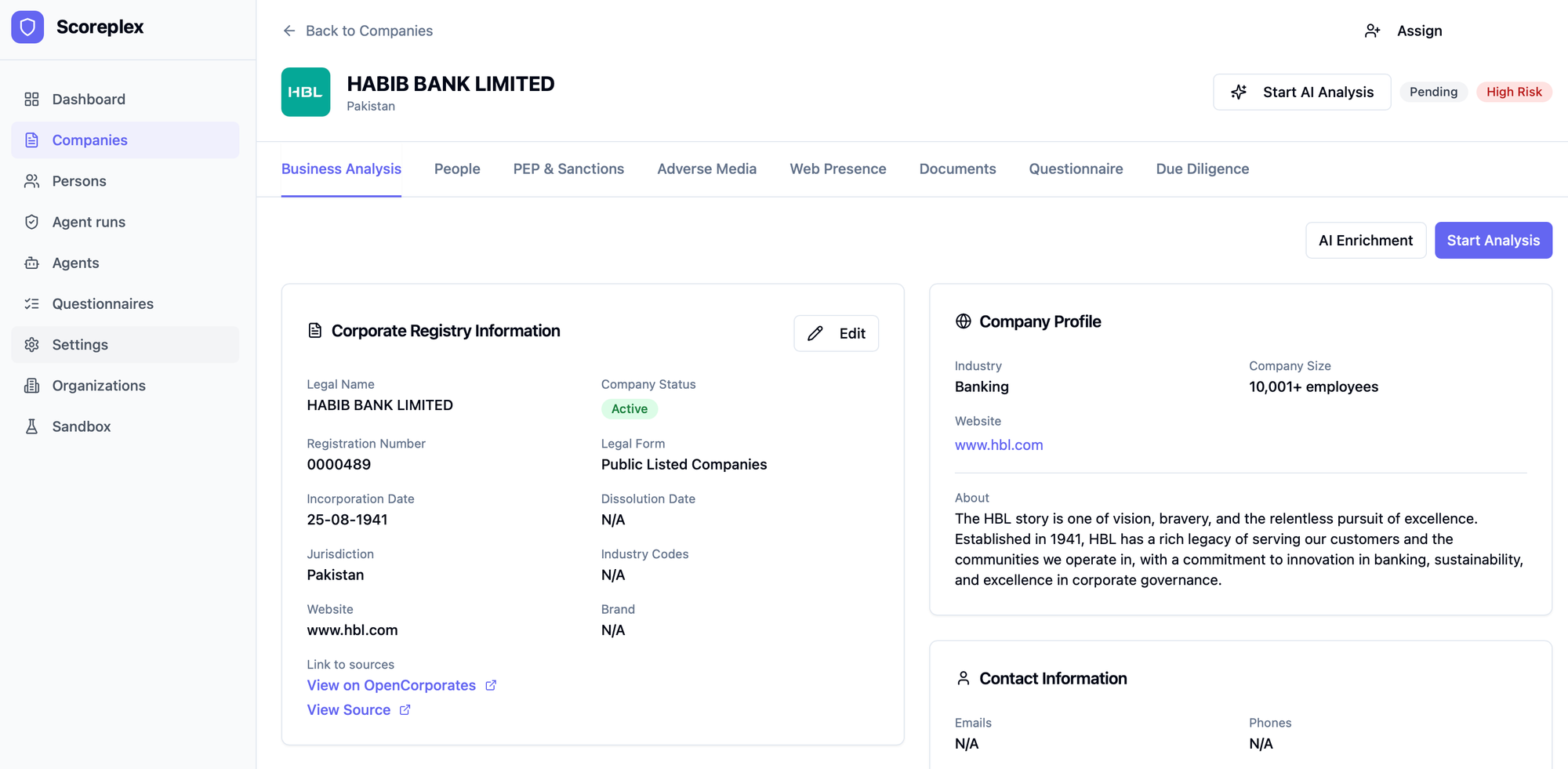
Scoreplex KYB AI-Coworker is an AI-powered KYB workflow that assembles a standardized, audit-ready case file end-to-end, from business identity and digital footprint to documents and a final due diligence narrative.
It builds a structured company baseline, consolidates web presence into a single evidence pack, and manages documents and questionnaires with clear statuses and traceable source links.
Registry, UBO, sanctions & PEP: Enriches the baseline with registry data, maps ownership and control to identify UBOs and related parties, and runs sanctions/PEP screening with evidence-linked sources.
Web presence check: Normalizes website, domain, social, third-party profile, and review signals into consistent categories with source links.
Document verification: Extracts KYB fields via OCR/NLP, cross-checks against documents, registries (where available), and questionnaires, and returns an exception list of gaps and mismatches.
Adverse media analysis: Collects broadly, deduplicates and ranks results, reduces name-collision noise, and clusters coverage into risk-labeled events with evidence-linked sources.
Due diligence narrative: Generates an AI-drafted, report-ready narrative that explains the risk outcome and cites the evidence trail.
AI agent constructor: Lets teams configure workflows, checks, and outputs to their needs while preserving an audit-ready trail.
The output is one consistent case file per counterparty, reducing manual assembly and speeding reviews by focusing analysts on exceptions rather than collection.