
Architecture, Use Cases, and the Future of AI-Driven Compliance Automation
Financial institutions operate in one of the most complex regulatory environments in the global economy. Anti-money laundering rules, sanctions regimes, beneficial ownership transparency laws, and cross-border compliance obligations continue to expand every year.
At the same time, businesses expect faster onboarding, digital customer journeys, and real-time access to financial services.
This tension creates one of the most persistent operational problems in modern financial services: compliance workflows move significantly slower than the businesses they regulate.
Corporate onboarding can still take weeks or even months for complex legal entities. Compliance analysts often move between multiple data systems, screening platforms, document repositories, and case management tools to complete a single investigation.
The issue rarely lies in data availability. Banks, fintech companies, and payment institutions already have access to corporate registries, sanctions databases, identity verification services, and adverse media monitoring platforms.
The real bottleneck is workflow orchestration. This is where a new category of regulatory technology is emerging: the compliance AI agent.
A compliance AI agent is designed to coordinate verification processes, gather intelligence from multiple sources, analyze risk indicators, and generate structured compliance reports supported by evidence.
Rather than replacing compliance professionals, these systems aim to transform how regulatory investigations are conducted.
Compliance AI Agent Definition
A compliance AI agent is a software system that autonomously executes regulatory verification workflows such as business verification, identity screening, sanctions monitoring, and due diligence analysis.
The system collects structured and unstructured information from multiple data sources, resolves entity identities across registries and intelligence databases, evaluates compliance risks, and produces structured investigation reports supported by verifiable evidence.
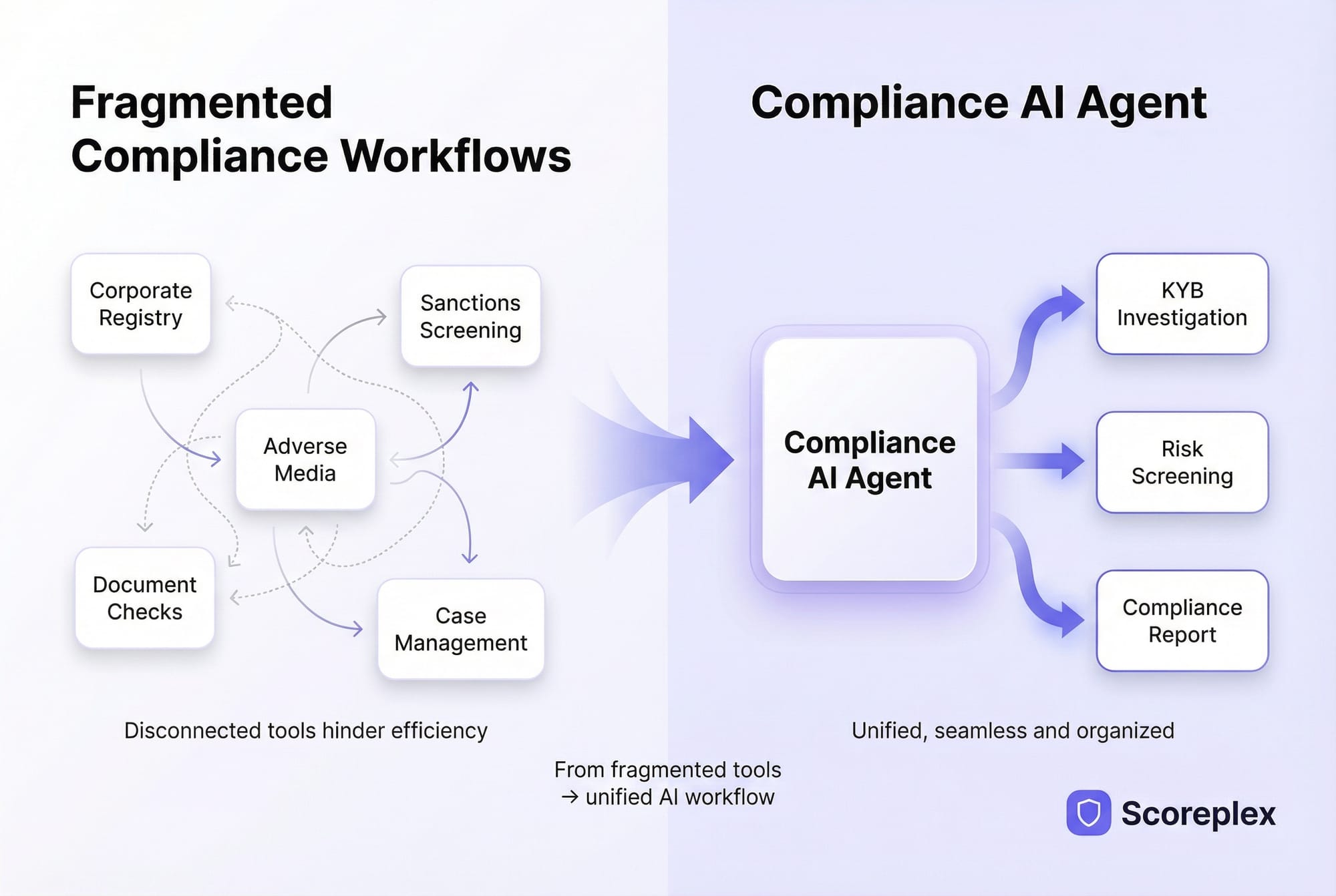
Traditional compliance software performs individual checks. A compliance AI agent orchestrates the entire investigation process.
The Compliance Workflow Problem
Compliance operations are among the most labor-intensive functions in financial institutions.
A typical corporate onboarding investigation requires analysts to interact with multiple systems:
• corporate registry databases
• sanctions screening platforms
• politically exposed person lists
• adverse media monitoring tools
• document verification systems
• internal compliance case management platforms
Each tool performs its task effectively, but none of them manages the entire investigation workflow.
As a result, analysts must manually coordinate the process. Registry data retrieved from one provider must be verified against another. Ownership structures must be reconstructed from filings. Screening alerts must be evaluated and documented. Evidence must then be compiled into narrative reports that regulators can review.
Research from McKinsey & Company indicates that onboarding corporate customers may take weeks depending on jurisdictional complexity and regulatory requirements.
Another challenge is screening noise. Sanctions monitoring systems frequently produce large volumes of alerts that investigators must manually review. Studies cited by Boston Consulting Group suggest that false positive rates in sanctions screening can exceed 90 percent.
Financial institutions therefore spend enormous resources on compliance operations. According to studies from LexisNexis Risk Solutions, the global cost of financial crime compliance continues to grow each year.
Detailed analysis of these operational bottlenecks is discussed in the Scoreplex research paper on AI agents reducing manual compliance investigations.
The underlying issue across institutions is consistent.
Compliance technology has historically evolved as collections of tools rather than integrated systems.
Compliance AI agents attempt to change that architecture.
What Is a Compliance AI Agent?
A compliance AI agent is an autonomous workflow system designed to manage regulatory investigations from intake to decision support.
Instead of returning isolated alerts or data records, the system coordinates multiple verification steps within a single structured investigation process.
A compliance AI agent typically performs tasks such as:
• retrieving corporate registry data
• mapping beneficial ownership structures
• screening companies and individuals against sanctions lists
• monitoring adverse media
• validating digital business presence
• linking evidence to risk conclusions
Modern platforms increasingly allow organizations to design customized verification workflows through an AI compliance agent builder.
This capability enables compliance teams to encode internal policies directly into automated investigation processes.
Types of Compliance AI Agents
Compliance AI agents can operate across several regulatory workflows depending on institutional requirements.
KYB AI Agents
Know-Your-Business verification is one of the most common applications. KYB AI agents analyze corporate entities by retrieving registry records, mapping ownership structures, and screening beneficial owners against sanctions and risk databases.
These systems help financial institutions accelerate corporate onboarding while maintaining regulatory transparency.
KYC AI Agents
Know-Your-Customer agents focus on identity verification. They analyze identity documents, perform sanctions and PEP screening, and evaluate digital identity signals.
AML Investigation Agents
Anti-money-laundering investigations often involve reviewing suspicious transaction alerts generated by transaction monitoring systems. AI agents assist investigators by gathering contextual information about associated entities and preparing investigation summaries.
Due Diligence AI Agents
Organizations frequently perform risk assessments on suppliers, partners, or acquisition targets. AI agents automate these investigations by aggregating corporate records, ownership information, and media coverage.
Continuous Monitoring Agents
Some compliance AI agents operate continuously rather than during onboarding only. These systems monitor entities for sanctions updates, adverse media events, or ownership changes.
Related Compliance AI Technologies
Compliance AI agents operate alongside several technologies used in regulatory automation:
• KYB automation platforms
• KYC identity verification systems
• sanctions screening software
• adverse media monitoring tools
• transaction monitoring AI
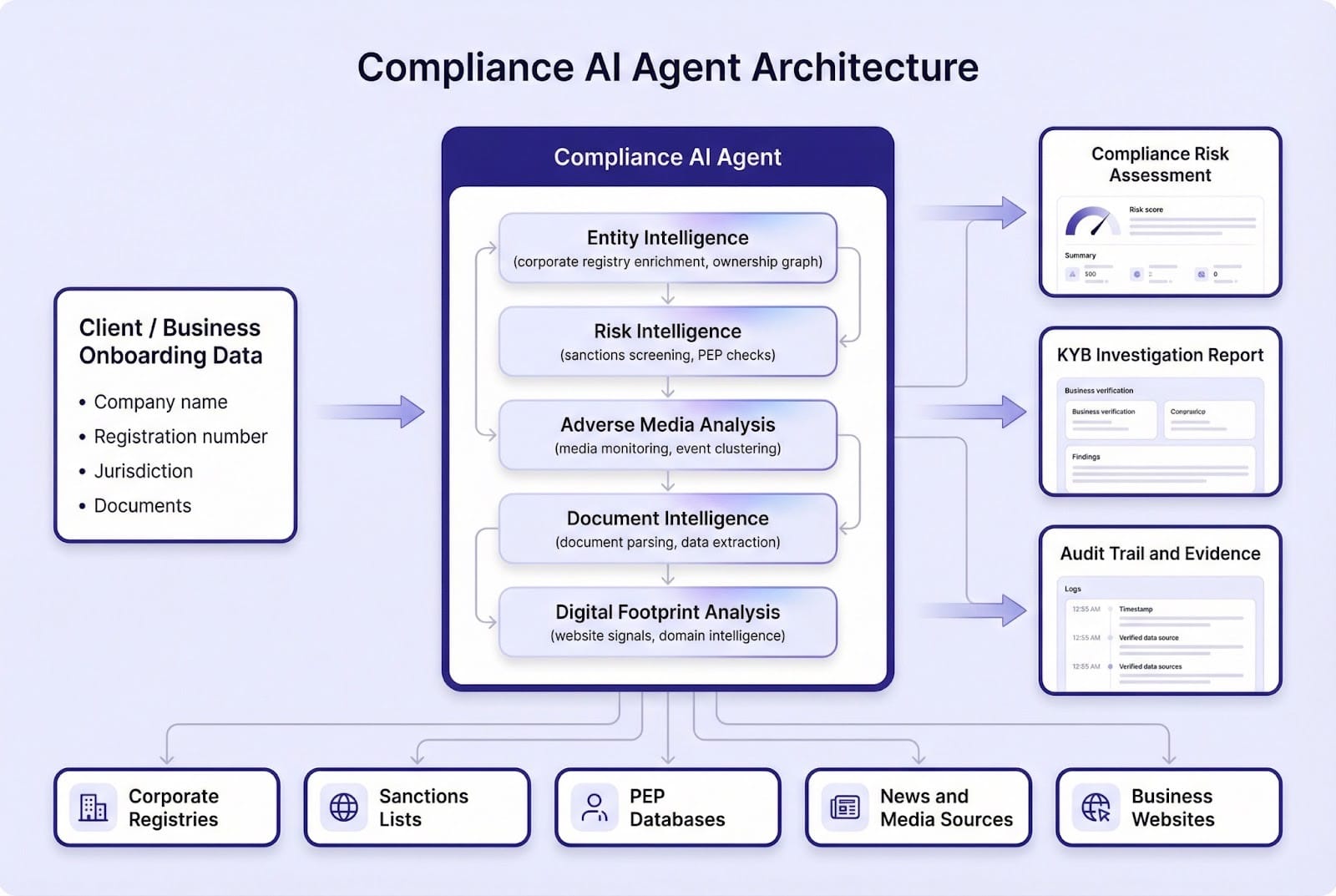
Core Architecture of a Compliance AI Agent
Compliance AI agents typically operate through several interconnected layers.
Entity Intelligence Layer
This layer retrieves corporate registry records and constructs ownership graphs. Directors, shareholders, and beneficial owners are extracted from filings and connected within structured relationship networks.
Entity resolution algorithms determine whether records across different databases refer to the same individual or organization.
Risk Intelligence Layer
The risk intelligence layer performs sanctions screening, politically exposed person checks, and adverse media monitoring.
Instead of returning raw matches, the system evaluates match confidence using structured attributes such as nationality, date of birth, or registration number.
Document Intelligence Layer
Compliance investigations often require reviewing documents such as incorporation certificates or shareholder registers. Document intelligence modules extract key information and structure it for analysis.
Digital Footprint Analysis
Shell companies often lack credible digital presence. Compliance AI agents analyze websites, domain registration history, and public contact details to evaluate whether business activity appears legitimate.
Evidence and Audit Layer
Every compliance conclusion must remain traceable. This layer stores registry extracts, sanctions records, and media references alongside the reasoning behind each compliance conclusion.
Narrative Compliance Engine
Finally, the system generates structured compliance reports explaining the investigation results.
Compliance AI Investigation Workflow
A typical compliance AI investigation process can be summarized in seven steps.
1 Entity intake
The system receives basic company information such as legal name, registration number, and jurisdiction.
2 Registry enrichment
Corporate registry records are retrieved automatically.
3 Ownership mapping
Directors, shareholders, and beneficial owners are identified and connected in an ownership graph.
4 Sanctions and PEP screening
The company and associated individuals are screened against sanctions and politically exposed person lists.
5 Adverse media analysis
News articles referencing the entity are collected and grouped into risk events.
6 Digital footprint verification
Website presence, domain age, and public business signals are analyzed.
7 Compliance report generation
All findings are compiled into a structured investigation report.
Compliance AI Agent vs Traditional Compliance Software
Traditional compliance systems focus on individual tasks rather than integrated workflows.
A broader overview of market solutions can be found in the Scoreplex analysis of leading platforms.
Compliance AI Agent Use Cases
Compliance AI agents are increasingly used across several regulated industries:
• digital banking onboarding
• crypto exchange compliance
• payment institution KYB verification
• supplier risk due diligence
• corporate partner screening
Benefits of Compliance AI Agents
Faster onboarding
Automated investigation workflows significantly reduce the time required to gather data and prepare compliance reports.
Reduced false positives
Entity resolution and contextual screening reduce the number of irrelevant alerts investigators must review.
Lower operational costs
Automation decreases the amount of manual investigation work required for each onboarding case.
Improved audit readiness
Evidence-linked reports ensure that compliance decisions remain transparent and defensible during regulatory audits.
Risks and Governance
Despite their advantages, compliance AI agents must operate within strict governance frameworks.
Regulators emphasize transparency, explainability, and human oversight in AI-supported decision processes. Guidance from the European Banking Authority highlights the importance of maintaining accountability in automated compliance systems.
Organizations implementing compliance AI agents should therefore ensure:
• traceable data sources
• explainable risk analysis logic
• human oversight for high-risk decisions
• comprehensive audit trails
AI agents assist compliance professionals rather than replacing them.
When Should Organizations Adopt Compliance AI Agents?
Adoption becomes particularly valuable when compliance workflows reach high levels of scale or complexity.
Organizations that benefit most include:
• digital banks
• fintech platforms
• crypto exchanges
• payment institutions
• B2B marketplaces
These environments frequently involve cross-border clients and complex ownership structures.
Case studies of major KYB failures caused by fragmented compliance workflows illustrate the risks of manual investigation processes.
Automation helps organizations reduce these risks while improving operational efficiency.
Key Takeaways
• A compliance AI agent orchestrates regulatory verification workflows across multiple data sources.
• These systems integrate registry intelligence, sanctions screening, media analysis, and document verification.
• Automation reduces investigation time and operational workload.
• Human oversight remains essential for final compliance decisions.
Frequently Asked Questions About Compliance AI Agents
What is a compliance AI agent?
A compliance AI agent is a system that automates regulatory verification workflows such as KYB, KYC, sanctions screening, and due diligence investigations. It gathers information from multiple sources, evaluates risk indicators, and produces structured compliance reports supported by evidence.
How is a compliance AI agent different from compliance software?
Traditional compliance software performs individual checks such as sanctions screening or document verification. A compliance AI agent orchestrates the entire compliance investigation workflow, integrating multiple verification steps into a unified process.
What processes can compliance AI agents automate?
Compliance AI agents can support business verification, identity checks, sanctions screening, adverse media monitoring, supplier due diligence, and continuous compliance monitoring.
Are compliance AI agents allowed by regulators?
Yes, provided that institutions maintain human oversight and ensure transparency in automated decision processes.
Which industries use compliance AI agents?
Banks, fintech companies, payment institutions, crypto platforms, and B2B marketplaces commonly deploy compliance AI agents to automate regulatory investigations.
What data sources do compliance AI agents use?
Compliance AI agents typically integrate corporate registries, sanctions lists, PEP databases, adverse media sources, and public business signals to perform regulatory investigations.
Can compliance AI agents reduce false positives?
Yes. By combining entity resolution, contextual screening, and multiple intelligence sources, compliance AI agents can significantly reduce false positives in sanctions and media monitoring.
About Scoreplex
Scoreplex KYB AI-Coworker is an AI-powered KYB workflow that assembles a standardized, audit-ready case file end-to-end, from business identity and digital footprint to documents and a final due diligence narrative.
It builds a structured company baseline, consolidates web presence into a single evidence pack, and manages documents and questionnaires with clear statuses and traceable source links.
Registry, UBO, sanctions & PEP: Enriches the baseline with registry data, maps ownership and control to identify UBOs and related parties, and runs sanctions/PEP screening with evidence-linked sources.
Web presence check: Normalizes website, domain, social, third-party profile, and review signals into consistent categories with source links.
Document verification: Extracts KYB fields via OCR/NLP, cross-checks against documents, registries (where available), and questionnaires, and returns an exception list of gaps and mismatches.
Adverse media analysis: Collects broadly, deduplicates and ranks results, reduces name-collision noise, and clusters coverage into risk-labeled events with evidence-linked sources.
Due diligence narrative: Generates an AI-drafted, report-ready narrative that explains the risk outcome and cites the evidence trail.
AI agent constructor: Lets teams configure workflows, checks, and outputs to their needs while preserving an audit-ready trail.
The output is one consistent case file per counterparty, reducing manual assembly and speeding reviews by focusing analysts on exceptions rather than collection.
Related Reading
- AI Compliance Agent Builder for KYB and KYC Automation
- Top 10 Compliance AI Agents in 2026
- Whitepaper: AI Agents in Compliance Operations
- Top 5 KYB Failures: What Went Wrong and What to Fix
Sources
- McKinsey & Company – Global Banking Annual Review
https://www.mckinsey.com/capabilities/risk-and-resilience/our-insights/global-banking-annual-review - Boston Consulting Group – Next Generation Sanctions Screening
https://www.bcg.com/publications/2019/next-generation-sanctions-screening - LexisNexis Risk Solutions – True Cost of Financial Crime Compliance
https://risk.lexisnexis.com/insights-resources/research/true-cost-of-financial-crime-compliance-study - European Banking Authority – Machine Learning in AML
https://www.eba.europa.eu/eba-publishes-report-use-machine-learning-anti-money-laundering