
Transforming Compliance with AI‑Powered Risk Intelligence
Financial crime, regulatory pressure, and globalized business relationships have dramatically increased the importance of Enhanced Due Diligence (EDD). Traditional manual investigations are no longer sufficient for modern compliance teams that must evaluate thousands of counterparties, vendors, investors, and corporate clients.
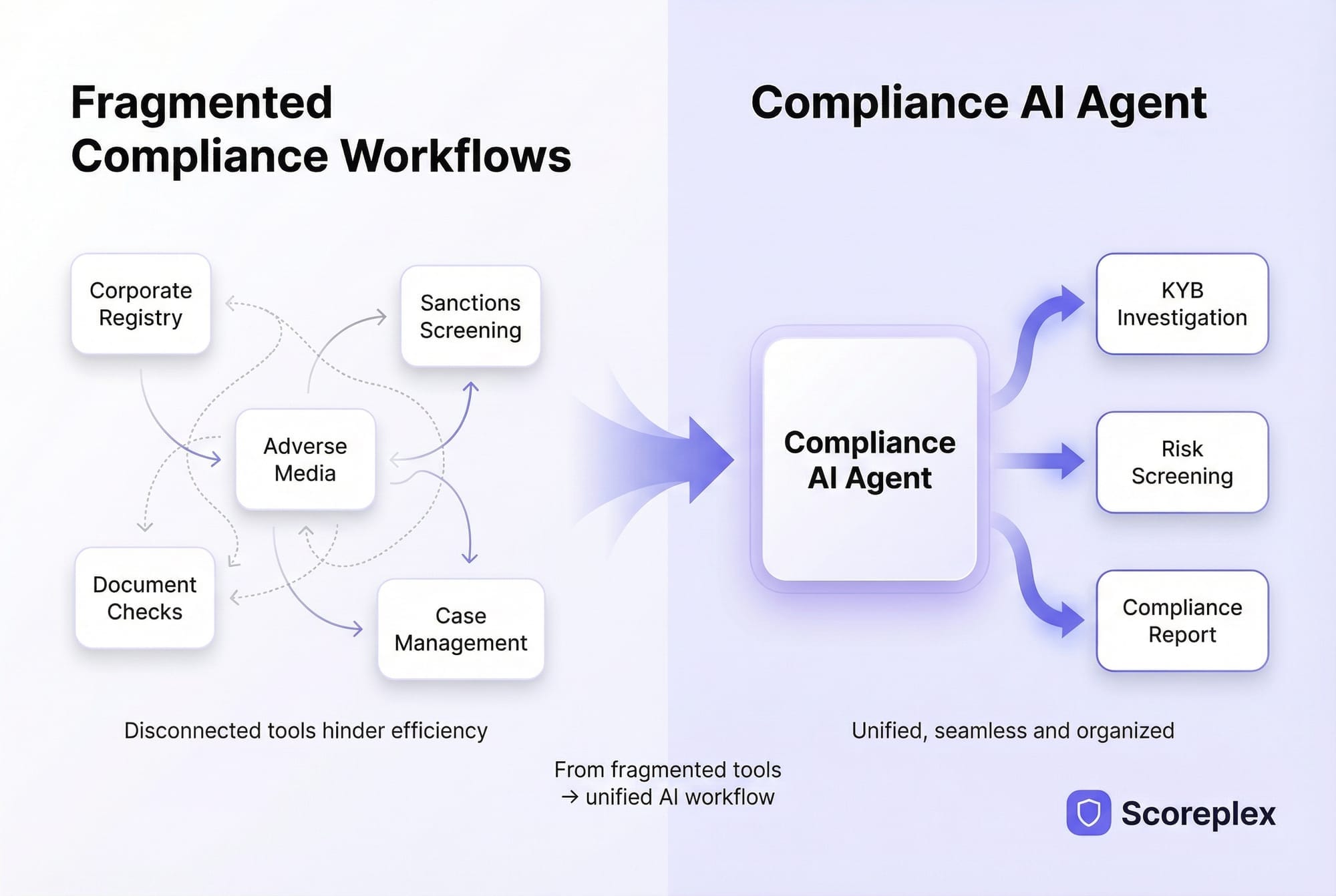
An Enhanced Due Diligence (EDD) AI agent is an automated intelligence system designed to conduct deep risk analysis on companies and individuals by combining regulatory databases, open-source intelligence (OSINT), corporate registries, and AI-powered analysis.
These AI agents transform what used to take analysts hours or days into an automated process completed in minutes while producing structured, explainable compliance reports.
Platforms such as Scoreplex demonstrate how AI agents can streamline the entire due diligence lifecycle—from entity discovery to narrative risk reporting.
This article explains how EDD AI agents work, what capabilities they provide, and why they are becoming essential infrastructure for modern compliance operations.
Understanding Enhanced Due Diligence (EDD)
Enhanced Due Diligence (EDD) is a deeper level of risk assessment required when a customer, vendor, or business partner presents elevated financial crime risk.
EDD is commonly required for:
- Politically exposed persons (PEPs)
- Cross-border corporate structures
- High-risk jurisdictions
- Complex ownership networks
- Large financial transactions
- Mergers and acquisitions
- Third-party vendor onboarding
Regulators expect organizations to perform comprehensive background checks, including verifying corporate structures, identifying beneficial owners, screening sanctions lists, and evaluating reputational risk.
Historically, analysts performed these checks manually by searching:
- Corporate registries
- Sanctions databases
- News sources
- Government filings
- Company websites
- Social media platforms
This process is time-consuming, expensive, and prone to human error.
This operational burden is well documented. Research from GLEIF found that onboarding a new client organization typically takes six weeks, and about 25% of the process remains manual, highlighting why traditional due diligence workflows struggle to scale
EDD AI agents solve this problem by automating data collection, risk analysis, and report generation.
What Is an EDD AI Agent?
An EDD AI agent is an autonomous software system that performs the tasks of a compliance analyst using artificial intelligence, data integrations, and investigative workflows.
The agent collects information from multiple sources, analyzes risk signals, and produces a structured compliance report summarizing findings.
Core capabilities include:
- Automated entity research
- Corporate ownership mapping
- Sanctions and PEP screening
- Adverse media detection
- Online presence analysis
- Corporate document verification
- AI-generated compliance narratives
Unlike simple data aggregation tools, EDD AI agents interpret information, identify hidden connections, and explain risk indicators.
EDD is one part of a wider shift toward autonomous compliance workflows. For a broader category view, read our explanation of what a compliance AI agent is and how it differs from traditional compliance software.
This allows compliance teams to scale investigations without increasing analyst workload.
Core Capabilities of an EDD AI Agent
Modern EDD AI systems combine several investigative modules. The following capabilities represent the core functionality used in advanced compliance platforms.
Corporate Registry Analysis
Corporate registry analysis is the foundation of any business due diligence investigation.
An EDD AI agent automatically queries national and international corporate registries to gather critical information about a company.
Typical registry data includes:
- Company legal name
- Registration number
- Incorporation date
- Registered address
- Directors and officers
- Shareholders
- Corporate status
- Filing history
AI agents normalize this data across jurisdictions and identify inconsistencies.
For example, the system can detect:
- Dormant companies acting as transaction counterparties
- Recently incorporated shell companies
- Entities registered in high-risk jurisdictions
- Frequent director changes
Automating registry research significantly reduces analyst workload while improving accuracy.
To see how this works in practice, explore our guide to a business analysis AI agent and how it automates company verification across registries, websites, and open sources.
Business Ownership Structure Analysis
Understanding who ultimately owns and controls a company is essential for compliance and anti-money laundering (AML) programs.
EDD AI agents reconstruct corporate ownership networks to identify beneficial owners and complex shareholding structures.
The system may map:
- Parent companies
- Subsidiaries
- Shareholders
- Ultimate Beneficial Owners (UBOs)
- Cross-border ownership layers
Advanced AI models detect patterns associated with risk, including:
- Multi-layer shell structures
- Ownership through offshore jurisdictions
- Circular ownership
- Hidden beneficial ownership
Visual ownership graphs allow compliance teams to quickly understand control relationships and risk exposure.
AI Data Enrichment
Raw corporate data is often incomplete or inconsistent. AI enrichment enhances the dataset by automatically gathering additional intelligence.
EDD AI agents enrich entities using:
- Open-source intelligence (OSINT)
- Business databases
- Web scraping
- Knowledge graphs
- Natural language processing
Enrichment may include:
- Industry classification
- Revenue estimates
- Company size
- Operational footprint
- Digital presence
- Related entities
AI enrichment enables compliance teams to obtain a holistic view of a business, even when official records are limited.
PEP & Sanctions Screening
Screening individuals and entities against Politically Exposed Persons (PEP) and global sanctions lists is a core compliance requirement, but it comes with significant challenges. A major issue is the high number of false positives. In actual AML systems, false positive rates can be very high — in some monitoring contexts up to 20–30% or more of alerts are non‑actionable due to common names, transliterations, or incomplete identifiers. False positives occur due to:
- Name variations and transliterations across languages
- Common names shared by multiple people
- Partial matches on aliases or abbreviations
- Ambiguous entity identifiers
High false positives slow down investigations, increase compliance costs, and risk delaying legitimate transactions.
How AI improves accuracy:
- Context-aware entity resolution: AI uses additional data such as location, date of birth, occupation, and corporate affiliation to determine whether a match is genuine.
- Fuzzy matching with risk weighting: Instead of exact string matches, AI evaluates similarity scores and ranks potential hits by risk severity.
- Continuous learning: Machine learning models improve over time by learning which alerts were true positives versus false positives.
- Cross-database reconciliation: AI agents compare multiple lists and historical data to filter out spurious matches, reducing false positives by up to 70% in advanced systems.
The result is a faster, more reliable PEP and sanctions screening process, enabling compliance teams to focus on true risks while maintaining regulatory coverage.
Adverse Media Screening
Adverse media screening detects negative press that may indicate legal, reputational, or financial risk. Traditional keyword-based methods often generate high volumes of false positives, sometimes exceeding 90%, because:
- Generic terms trigger irrelevant matches
- Articles may mention the same name in unrelated contexts
- Machine translation and multilingual content introduce ambiguity
The noise problem is not marginal. In a Dow Jones survey on adverse media screening, nearly half of respondents said that fewer than 5% of matches were true positives, which shows how inefficient keyword-heavy review workflows can become without contextual filtering.
AI-powered adverse media screening reduces false positives by:
- Natural Language Processing (NLP) contextual analysis: AI models analyze surrounding text to understand whether the article truly relates to the entity in question.
- Named Entity Disambiguation: Identifies the correct individual or company among multiple with similar names.
- Sentiment and risk scoring: Assigns risk levels based on content severity and credibility of sources.
- Multilingual intelligence: Automatically processes media in multiple languages, reducing missed risks while avoiding irrelevant alerts.
This approach increases both precision and recall, helping organizations detect genuine risks efficiently and reduce wasted analyst hours by up to 50–60%.
Web Presence Analysis
A company's digital footprint often reveals valuable intelligence.
EDD AI agents perform web presence analysis by evaluating the company’s online activity across multiple channels.
This includes three major areas.
Website Analysis
The system reviews the official company website to extract:
- Business description
- Product offerings
- Contact information
- Legal disclosures
- Domain registration data
Risk signals may include:
- Recently created domains
- Missing legal information
- Inconsistent company descriptions
- Suspicious hosting locations
Product Reviews and Reputation
AI agents scan public platforms to analyze customer feedback and product reviews.
This helps identify:
- Consumer complaints
- Fraud allegations
- Scam warnings
- Operational issues
Aggregated reputation signals provide additional insight into company credibility.
Social Media Analysis
Companies frequently communicate through social media platforms.
EDD AI agents analyze social media activity to identify:
- Corporate messaging
- Executive profiles
- Customer engagement
- Public controversies
- Community sentiment
This provides context that may not appear in official corporate filings.
Incorporation Documents Verification
Verifying official documents is a critical step in the due diligence process.
EDD AI agents automatically review documents such as:
- Certificates of incorporation
- Articles of association
- Shareholder registers
- Director appointment records
- Business licenses
AI document analysis can detect:
- Missing pages
- Altered documents
- Data inconsistencies
- Mismatched company identifiers
Optical character recognition (OCR) and document comparison algorithms enable automated verification at scale.
Narrative Compliance Report Generation
One of the most valuable outputs of an EDD AI agent is a structured narrative compliance report.
Instead of presenting raw data, the AI synthesizes findings into a readable investigation summary.
Typical report sections include:
- Entity overview
- Corporate registry summary
- Ownership analysis
- Sanctions and PEP results
- Adverse media findings
- Web presence insights
- Document verification results
- Overall risk assessment
The narrative report explains why a company may pose risk, helping compliance teams and auditors understand the reasoning behind the analysis.
This also creates an audit-ready documentation trail for regulatory reviews.
Benefits of Using an EDD AI Agent
Adopting an AI-driven EDD agent provides quantifiable improvements across speed, accuracy, and operational efficiency.
The economic case for automation is becoming harder to ignore. LexisNexis estimates that financial crime compliance costs in the U.S. and Canada have reached $61 billion, while 99% of financial institutions report rising compliance costs. This is one of the clearest reasons why AI-driven EDD tools are moving from experimentation to operational necessity.
Overall, EDD AI agents enable organizations to detect, analyze, and mitigate risk more effectively than traditional manual processes.
Use Cases for EDD AI Agents
EDD AI agents are versatile tools for multiple industries and risk scenarios:
Banking and Financial Services:
- Screening corporate clients, beneficial owners, and high-risk transactions.
- Reducing investigation times for new accounts by 70–80%.
- Continuous monitoring of transaction counterparties for evolving sanctions risk.
Fintech & Payment Platforms:
- Onboarding merchants and partners with automated corporate verification.
- Detecting fraud and financial crime patterns before payments are processed.
- Enhancing trust and security for cross-border transactions.
Venture Capital & Private Equity:
- Performing automated due diligence on portfolio companies and target acquisitions.
- Mapping complex ownership structures to uncover hidden UBOs or offshore entities.
- Integrating adverse media and PEP screening for investment risk evaluation.
Corporate Procurement & Vendor Management:
- Screening third-party vendors for legal, reputational, and operational risk.
- Monitoring supply chain entities continuously to ensure compliance with sanctions regulations.
Cryptocurrency and Web3 Platforms:
- Screening counterparties, token issuers, and DeFi protocols for AML and KYC compliance.
- Detecting connections to high-risk jurisdictions or PEP-controlled entities.
- Reducing fraudulent activity risk in digital asset transactions.
Cross-Border Trade & Export Compliance:
- Identifying sanctioned entities in global supply chains.
- Ensuring compliance with local and international trade regulations.
- Reducing fines and reputational risks from inadvertent dealings.
These use cases highlight that any organization dealing with multiple counterparties, cross-border transactions, or high-risk individuals benefits significantly from AI-driven EDD.
The Future of AI-Driven Due Diligence
As global regulations become stricter and business networks grow more complex, the demand for automated compliance intelligence will continue to increase.
Future EDD AI agents will likely incorporate:
- Knowledge graph risk mapping
- Continuous monitoring of counterparties
- Predictive risk scoring
- Real-time sanctions updates
- Cross-entity relationship detection
These capabilities will transform compliance from a reactive process into a proactive risk intelligence system.
Conclusion
Enhanced Due Diligence is a critical component of modern risk management, but traditional manual investigations are no longer scalable.
An EDD AI agent automates the entire investigative workflow—from corporate registry research to sanctions screening and narrative compliance reporting.
By combining corporate data analysis, AI enrichment, media monitoring, and document verification, these systems provide compliance teams with faster, more accurate risk assessments.
Platforms like Scoreplex demonstrate how AI can turn complex due diligence investigations into a streamlined, automated process.
As regulatory expectations continue to rise, organizations that adopt AI-driven EDD will gain a significant advantage in risk detection, operational efficiency, and compliance readiness.
FAQ Section
Q1: What is Enhanced Due Diligence (EDD)? A: EDD is an in-depth investigation process for high-risk clients, going beyond standard KYC to assess risk comprehensively.
Q2: How long does EDD take? A: Traditional EDD can take 2–20 days. AI-driven EDD reduces this to minutes.
Q3: Can AI automate due diligence? A: Yes. AI agents can autonomously gather data, analyze risk, and generate reports for EDD.
Q4: What are AI agents in compliance? A: Autonomous systems that perform multi-step EDD workflows, including research, risk scoring, and reporting.
Q5: Is AI allowed in AML compliance? A: Yes, provided organizations maintain human oversight, auditability, and regulatory adherence.
About Scoreplex
Scoreplex is a KYB AI-coworker that automates customer due diligence, minimizes false positives, streamlines document verification, and generates comprehensive narrative reports.
How it works:From a single company input, it produces a complete business risk profile, including::
- Official registry checks with UBO identification and full ownership chains
- Global sanctions and PEP screening
- Real-time adverse media monitoring with structured events and source attribution
- Automated document verification (incorporation records, address validation)
- Website analysis and cross-checks of company details, products, contacts, and locations
- Product and customer review analysis (Trustpilot, G2, Google Reviews)
- Social media analysis of corporate accounts and profiles of founders and directors
- High-risk country exposure assessment based on aggregated signals
- A structured risk summary highlighting red flags, rationale, and direct source links
Built for Faster, Smarter KYB Decisions:
- 10× faster KYB reviews through end-to-end automation
- Up to 10× lower costs compared to traditional KYB service providers
- Significantly fewer false positives driven by registry-first matching and transparent risk signals